Oriental garden lizard

The oriental garden lizard, also called the estern garden lizard, common garden lizard, indian garden lizard, bloodsucker or changeable lizard, is an agamid lizard found widely disttributed in indo-malaya. It has also been introduced in many other part of the world.
Changeable lizards escape danger by darting to the nearest tree. If the predator comes even closer, they will scale to the side of the tree facing away from the preadator and very swiftly dart up the tree. The predator looks behind the tree only to see that the lizards is up in the branches.

The common green garden lizard (Location- Sri Lanka)
During the breeding season, the male's head and shoulders turns bright orange to crimson and his throat black. Males also turn red headed after a successful battle with rivals. Both males and females have a crest from the head to nearly the tail, hence their other common name, "Crested tree lizard".

Red headed garden lizard (Location- Sri Lanka)
Unlike someother lizards, they do not drop their tails (Autotomy), and their tials are very long, stiff and pointy. Like other reptiles, they shed their skins, like chameleons, changeable lizards can move each of their eyes in different directions.
The lizard has a bright green dorsal coloration, usually with 5 or 6 white, cream or dark green transverse stripes, however these are changeable. Often the stripes continue on to the tail. The head is yellowish or brownish- green whereas the male develops a bright red head and throat in the breading seasons.
Young and immature sometimes have a whitish dorso- lateral sripes.
Where they live?
Oriental garden lizars occur in Afghanistan, Bangladesh, Iran, Bhutan, Cambodia, China, India, Sri Lanka, Pakistan, Indonesia, Malaysia, Maldives, Mauritius, Nepal, Pakistan, Philippines, Thailand, Vietnam. These lizards are found in a wide range of habitats and apper to adapt well to humans. They are commonly found amoung the undergrowth in open habitats including highly urban areas.
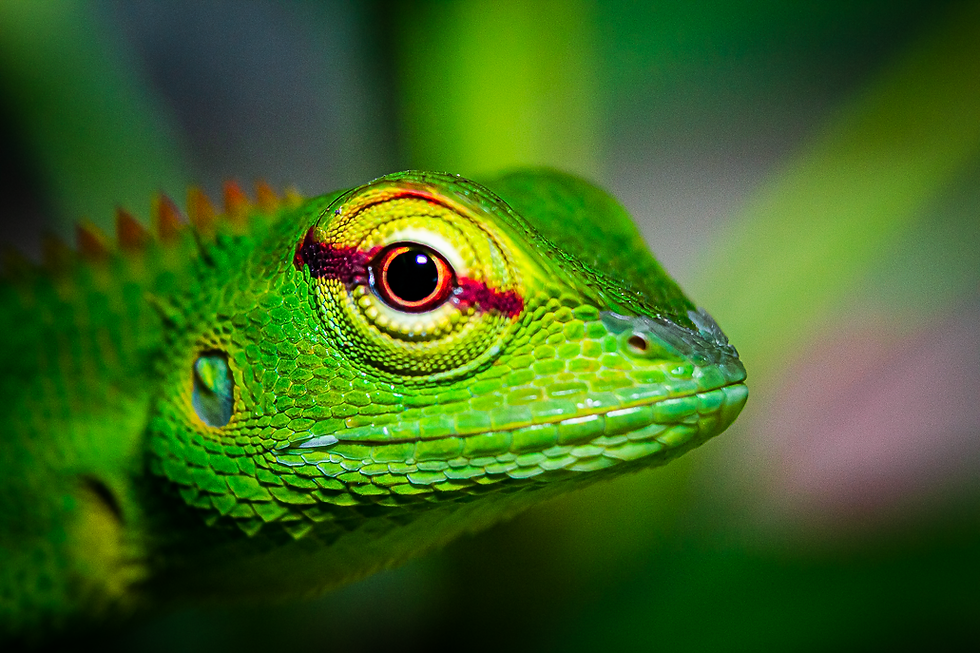
Head of common garden lizard (Location- Sri Lanka)
Habbits and lifestyle.
The oriental garden lizards spend most of their time in low shrubs and tree trunks, trying to stay undetected. They are solitary and diurnal, on a hot sunny day may be offten to seen on a twig or an wall, basking in the sun , with wide open mouth.
After a shower or rain number of these lizards may come down on the underground and pick up the larva and small insects that fall from the trees during the showers.
Oreintal garden lizards have teeth, that are designed for gripping the prey and not tearing it up. So they shallow their prey whole after it. Oreintal garden lizars normally live up to 5 years.
What do oriental garden lizards eat?
Oriental garden lizards are carnivores (insectivores). They eat mainly inscets such as crickets, grasshoppers, ants, and small vertebrates, including rodents and other lizarsd.
Do Oriental garden lizards bites humans?
They will often to bite when handled but rarely is strong enough to draw blood. Conservation satus and threats; is a widespread and common spiecies that has adapted well to humans and has no known conservation threats.

Oriental garden lizard. (Location- Sri Lanka)


Comments